

NFL Guide for Beginners: Watch Games Without Cable, Scores, Overtime Rules & Playoff Seeding
Written By Dilshad AhmadPublished: 18 October 2026 • 10:19 PM IST
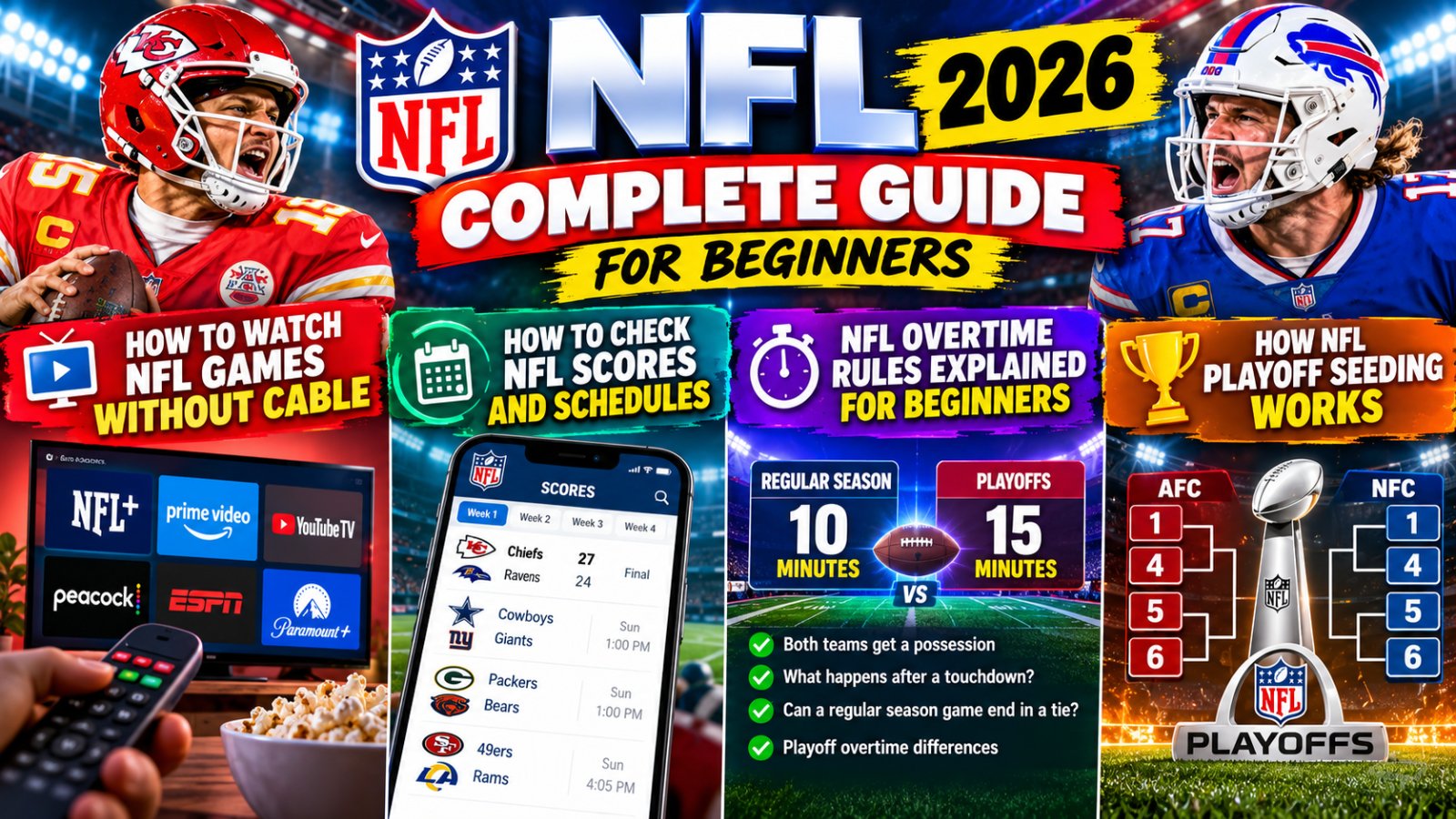
The NFL can be confusing when you are new to American football. Games appear on different networks and streaming services, scores include unfamiliar abbreviations, overtime has special rules, and playoff standings depend on more than simply winning a division. This guide explains all four topics in plain English so you can follow the 2026 NFL season with confidence.
Streaming services, antenna, and local broadcasts.
Live updates, standings, and weekly schedules.
Possessions, extra time, and game-winning scores.
Seeds, byes, wild cards, and tiebreakers.
1. How to Watch NFL Games Without Cable
You do not necessarily need a traditional cable TV subscription to watch NFL games in the United States. Depending on your location and the game, you may be able to use an over-the-air antenna, a streaming service, or the NFL's own digital services.
The important detail is that no single streaming service should be assumed to carry every NFL game live. Broadcast rights differ by network, game, location, and subscription. Check the official game listing before paying for a service.
NFL Streaming Options Compared
| Option | What It Can Offer | Important Limitation |
|---|---|---|
| Over-the-air antenna | Local CBS, FOX, NBC, or other available broadcast stations, depending on your area and their schedules. | Reception and available games depend on your location. An antenna does not unlock every nationally televised game. |
| Paramount+ | Eligible live local CBS NFL broadcasts through the service. | It is not a universal source for every NFL game. Check the local CBS game and current plan details. |
| Peacock | Eligible NBC football coverage, including designated Sunday night games. | Availability depends on the event, current rights, and subscription terms. |
| ESPN services | Eligible ESPN/ABC NFL coverage, depending on the service and game. | Check which ESPN product includes the particular game and whether it is available in your area. |
| Amazon Prime Video | Thursday Night Football and other games specifically assigned to Amazon. | It does not replace every broadcast network or out-of-market package. |
| YouTube TV | Live TV channels included in your plan and NFL Sunday Ticket when separately subscribed to and available. | Channel packages, local coverage, and Sunday Ticket pricing are separate considerations. Confirm the current package. |
| NFL+ | Live local and nationally televised games on supported mobile devices, plus other features depending on the tier. | Live-game device restrictions apply. It is not a general replacement for watching every live game on a television. |
| NFL Sunday Ticket | Eligible out-of-market Sunday afternoon games through its authorized distribution options. | It generally does not include games that are nationally exclusive or your local Sunday afternoon broadcasts as part of the out-of-market package. |
| Live TV streaming bundles | Services such as Hulu + Live TV or other packages may include several major sports networks. | Check the exact channel lineup, regional availability, price, and local game coverage before subscribing. |
Streaming rights and packages can change. For the most accurate game-by-game answer, use the NFL's official Ways to Watch guide and the league's official support center.
Which NFL Streaming Option Should You Choose?
If you mainly watch your local team: Check which games are carried by local CBS and FOX affiliates. An antenna may be sufficient for many local over-the-air games if you receive the stations clearly.
If you want Sunday night games: Check the current NBC/Peacock broadcast listing and the available plan in your location.
If you follow Thursday night games: Check Amazon Prime Video's NFL listing for the scheduled matchup.
If you want out-of-market Sunday afternoon games: Compare NFL Sunday Ticket with your other viewing options. Confirm which games are included before purchasing.
If you mainly watch on your phone: Review NFL+ features and device restrictions. Do not assume a mobile live stream will also work on a connected television.
How to Set Up NFL Streaming Step by Step
Open the official NFL schedule and select the matchup you want to watch.
Look for the listed network or streaming platform. Local broadcasts can vary by market.
Check subscription prices, trial terms if offered, supported devices, and whether the game is included.
Use your smart TV, streaming device, computer, phone, or tablet as supported by the service.
Sign in, confirm your subscription, and check the game listing before the broadcast starts.
Find Where a Game Is Streaming
Use the NFL's official guide to review viewing options based on your location and available services.
Open NFL Ways to Watch ↗2. How to Check NFL Scores and Game Schedules
The easiest way to follow an NFL season is to use a reliable schedule and live-score source. The schedule tells you when a game is supposed to begin and where to watch it. A live scoreboard tells you the current score, quarter, game clock, and other game details.
Best Places to Check NFL Scores
| Source | Useful For | What to Check |
|---|---|---|
| NFL.com | Official schedules, scores, standings, and game information. | Matchup, kickoff time, final score, and current standings. |
| NFL App | Following teams and checking game updates on supported devices. | Team pages, scores, alerts, and available video features. |
| ESPN | Scoreboards, game summaries, statistics, and sports coverage. | Live score, quarter, time remaining, and box score. |
| Network apps | Watching a game when the network has the relevant rights. | Broadcast availability and provider or subscription requirements. |
Official starting points:
How to Find Your Team's Next Game
NFL Scoreboard Terms Explained
| Term | Meaning |
|---|---|
| Q1, Q2, Q3, Q4 | The first, second, third, and fourth quarters. |
| 1st & 10 | First down with 10 yards to go to earn another first down. |
| Possession | The team currently controlling the ball. |
| TO or Timeout | A stoppage requested under the rules by a team. |
| OT | Overtime, played when the score is tied at the end of regulation. |
| Final | The game has ended and the displayed score is final. |
| W-L-T | Wins, losses, and ties in a team's record. |
| PF / PA | Points for and points against in standings tables. |
How to Read a Live Score
Example only. These are not live NFL scores.
In this example, the home team is ahead 24–21 with 2 minutes and 15 seconds remaining in the fourth quarter. The game is not over yet. The other team may still have time to score, so the result should not be treated as final until the game ends.
3. NFL Overtime Rules Explained for Beginners
Overtime happens when the teams are tied at the end of the fourth quarter. The NFL uses different overtime lengths for regular-season games and postseason games. Under the rules adopted for the 2025 season, both teams get an opportunity to possess the ball in regular-season overtime as well as in the playoffs, subject to the rulebook's specific exceptions.
Regular season
Each playoff OT period
Get a possession opportunity
Overtime periods and possession opportunities follow the official rulebook. The regular season can end in a tie; postseason play continues until a winner is determined.
How Regular-Season Overtime Works
When regulation ends in a tie, the referee conducts an overtime coin toss.
The opening possession begins, and the first team attempts to score.
Even if the first team scores a touchdown, the opposing team generally gets a chance to possess the ball under the current rules. A specific safety exception applies.
If one team is ahead after both teams have had their opportunity, that team wins. If the score remains tied, play continues under the overtime scoring rules.
Regular-season overtime is limited to one 10-minute period. If the score is still tied when it ends, the game can finish as a tie.
A Simple Overtime Example
| Scenario | What Happens |
|---|---|
| Team A scores a touchdown first. | Team B generally still gets a possession opportunity under the current rules. |
| Team A scores a field goal first. | Team B gets a chance to respond. The score after the relevant possessions determines whether the game continues. |
| Team B takes the lead after both teams have had a possession opportunity. | Team B wins if the applicable overtime conditions are satisfied. |
| The score remains tied when regular-season overtime expires. | The game can end in a tie. |
| The receiving team commits a safety on its initial overtime possession. | The NFL rulebook includes a specific exception under which the kicking team wins. |
How Playoff Overtime Is Different
Playoff games must produce a winner. Overtime begins with a coin toss and a 15-minute period. Both teams receive an opportunity to possess the ball, subject to the rulebook's safety exception. If the game remains tied, additional overtime periods are played until a winner is determined.
One 10-minute overtime period. A tie is possible.
15-minute overtime periods repeat until there is a winner.
For the official wording, consult the NFL's NFL Rulebook, particularly Rule 16, Overtime Procedures. You can also review the league's featured rules and approved rule changes.
4. How NFL Playoff Seeding Works
The NFL has two conferences: the American Football Conference (AFC) and the National Football Conference (NFC). Each conference has four divisions, and each division has four teams. After the regular season, seven teams from each conference qualify for the playoffs, making 14 playoff teams in total.
Each conference's playoff field consists of four division champions and three wild-card teams. Division champions receive seeds 1 through 4 based on their records and applicable tiebreakers. The three best remaining qualifying teams become wild cards, seeded 5 through 7.
The Seven Seeds in Each Conference
Division winner
Division winner
Division winner
Wild card
Wild card
The final qualifying team in the conference
Illustration of the seeding structure, not actual 2026 team standings.
What Is a First-Round Bye?
The No. 1 seed in each conference receives a bye during the Wild Card round. That team does not play in the opening round and advances directly to the Divisional round. The other six teams in the conference play three Wild Card games.
The bye is valuable because the top seed avoids an extra playoff game that week. The No. 1 seed also has home-field advantage for its conference playoff games, provided it keeps advancing, although the Super Bowl is played at its designated neutral-site venue.
How the Wild Card Round Matchups Work
The No. 1 seed rests during this round and enters in the Divisional round.
After the Wild Card round, the No. 1 seed faces the lowest remaining seed in its conference. The other two remaining teams play each other. Winners advance to the conference championship game, and the AFC and NFC champions meet in the Super Bowl.
The NFL Playoff Journey at a Glance
Teams compete for division titles and wild-card places.
Seeds 2–7 play; seed 1 receives a bye.
Four teams remain in each conference.
One AFC champion and one NFC champion emerge.
The AFC champion faces the NFC champion.
What Happens When Teams Have the Same Record?
A team's win-loss record matters, but it is not always enough to determine its playoff position. The NFL uses official tiebreaking procedures to rank teams that finish with identical records. The applicable order depends on whether the tie is within a division or among teams competing for wild-card positions.
| Tiebreaking Factor | Plain-English Explanation |
|---|---|
| Head-to-head | How the tied teams performed against each other, when this criterion applies. |
| Division record | How a team performed against opponents in its own division. |
| Common games | Results against shared opponents, under the applicable rules. |
| Conference record | Performance against teams in the same conference. |
| Strength of victory | The combined winning percentage of the teams a club defeated. |
| Strength of schedule | The combined winning percentage of a team's opponents. |
These are examples of key tiebreakers, not a complete universal sequence for every possible tie. The NFL's official procedure lists additional criteria and applies them in a defined order. A tie among three or more teams may also require the procedure to restart when the number of tied teams changes.
Read the full NFL Tiebreaking Procedures before trying to calculate a complicated playoff scenario.
A Simple Example of Playoff Seeding
Imagine that the Dallas Cowboys win their division and finish with a stronger record than the other division champions in the NFC. If they qualify as the No. 1 seed, they receive the first-round bye. A different division champion could be seeded No. 2, while the strongest non-division-winning qualifiers could fill seeds 5, 6, and 7.
This is a hypothetical illustration, not a prediction of the 2026 standings. Actual seeds depend on completed games and official tiebreakers. Winning a division guarantees a division-champion place in the seeding structure, but it does not automatically guarantee the No. 1 seed.
5. How to Follow the NFL Season More Easily
With games spread across different days, networks, and streaming platforms, a simple routine can help you keep track of your favorite team without paying for unnecessary services.
Your Weekly NFL Checklist
6. Frequently Asked Questions About the NFL
1. Can I watch NFL games without cable?
Yes. Depending on the game and location, options may include an over-the-air antenna, streaming services such as Paramount+ or Peacock for eligible broadcasts, Amazon Prime Video for designated games, live-TV streaming packages, and NFL+. Out-of-market Sunday afternoon games may require NFL Sunday Ticket. Check the official listing before subscribing.
2. What is the best place to check live NFL scores?
The official NFL Scores page and NFL app are strong starting points. ESPN also provides scoreboards and game statistics. Check the timestamp and game status if the score appears delayed.
3. How long is NFL overtime?
Regular-season overtime is one 10-minute period. Postseason overtime uses 15-minute periods and continues until a winner is determined. Both teams generally receive a possession opportunity under current rules, subject to the rulebook's specific exception.
4. Can an NFL regular-season game end in a tie?
Yes. If the score is tied at the end of the single 10-minute regular-season overtime period, the game can end in a tie. Playoff games continue through additional overtime periods until there is a winner.
5. How many teams make the NFL playoffs?
Fourteen teams qualify: seven from the AFC and seven from the NFC. Each conference sends four division champions and three wild-card teams.
6. What does the No. 1 NFL playoff seed receive?
The No. 1 seed in each conference receives a first-round bye. It enters the playoffs in the Divisional round and has home-field advantage for its conference playoff games as long as it continues advancing.
7. Do division winners always get the top four seeds?
Division champions are seeded 1 through 4 in their conference, while wild-card teams occupy seeds 5 through 7. However, winning a division does not automatically make a team the No. 1 seed.
8. What is an NFL wild-card team?
A wild-card team qualifies for the playoffs without winning its division. Three wild-card teams from each conference join the four division champions.
9. What happens when two NFL teams have the same record?
The NFL applies official tiebreaking rules. Depending on the situation, these can include head-to-head results, division record, common games, conference record, strength of victory, and strength of schedule, followed by additional criteria if needed.
10. Where can I find the official NFL schedule?
Visit NFL.com/schedules for the league's schedule. Use the official scores page for results and live game information.
11. Does NFL+ let me watch every NFL game live on my TV?
No. NFL+ live-game access has device and broadcast restrictions. Its live local and nationally televised game offering is primarily for supported mobile devices. Review the current plan details and the NFL's official support information before subscribing.
12. How many games are played in the NFL playoffs?
The 14-team playoff format includes six Wild Card games, four Divisional games, two conference championship games, and the Super Bowl: 13 postseason games in total, assuming the season follows the standard format.
Final Thoughts
You do not need to be a football expert to enjoy the NFL. Start by checking the schedule and choosing a legal way to watch the games you care about. Use a reliable scoreboard to follow the action, remember that overtime rules differ between the regular season and playoffs, and use official standings to understand how teams qualify.
The biggest playoff lesson is simple: seven teams from each conference qualify, the No. 1 seed earns a bye, and division champions receive seeds 1 through 4. When teams have matching records, official tiebreakers determine their positions. These basics make it much easier to understand the season as it unfolds.
Official NFL Resources
Disclaimer: This article is an independent educational guide and is not affiliated with or endorsed by the NFL. Streaming availability, subscription prices, broadcast rights, schedules, and rules may change. Confirm current information through official NFL and service-provider sources before making viewing or subscription decisions.