

World Space Week 2026: Theme Rocket Revolution, History, Importance, ISRO, NASA and Space Technology
Written By Dilshad AhmadPublished: 11 October 2026 • 09:31 PM IST
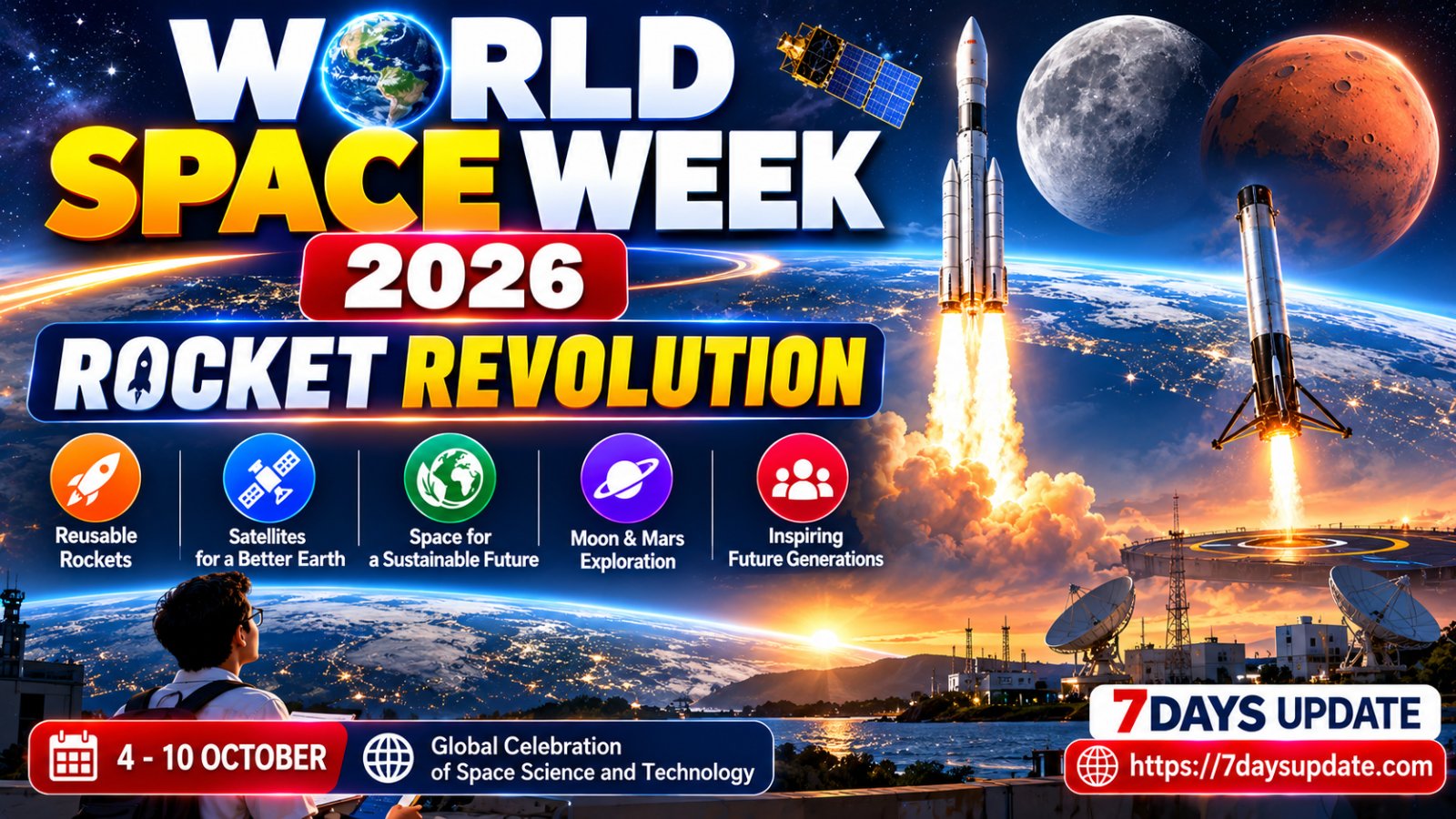
Space exploration is changing rapidly. Rockets that once belonged almost exclusively to large government space programmes are now part of a much wider ecosystem involving private companies, research institutions, universities and new space businesses. Reusable launch vehicles, smaller satellites and new commercial launch services are changing how humanity reaches space and what it can do once it gets there.
These developments were at the centre of World Space Week 2026, the international celebration held from October 4 to October 10, 2026. This year's theme was “Rocket Revolution”, highlighting how new launch technologies are transforming access to space. The subject connects rocket engineering with satellite services, scientific discovery, space business, education and the future of exploration beyond Earth.
World Space Week is not simply about watching rockets launch. It is also an opportunity to understand how space technology affects everyday life, why countries invest in space science, what students can learn from space missions and how the next generation of launch systems could change the global space industry.
World Space Week 2026: At a Glance
- Event: World Space Week 2026
- Dates: October 4–10, 2026
- Theme: Rocket Revolution
- Main focus: The changing technology and economics of launching payloads into space
- Who can participate: Students, teachers, researchers, space enthusiasts, institutions and the general public
- Global coordination: World Space Week Association, working in connection with the United Nations' space outreach framework
What Is World Space Week?
World Space Week is an annual international observance that celebrates the contributions of space science and technology to society. It encourages people to explore the science behind rockets, satellites, astronomy, planetary missions and the wider space industry.
The observance was proclaimed by the United Nations General Assembly in 1999 through Resolution 54/68. It is held every year from October 4 to October 10, giving schools, universities, science organisations and space enthusiasts a shared period to organise educational and public outreach activities.
The purpose is broader than celebrating famous astronauts or major launches. Space science supports weather forecasting, communications, navigation, disaster monitoring, environmental research and many other services that people use on Earth.
World Space Week also encourages international cooperation. Space missions often involve complex scientific questions, long-term investments and technology developed by teams across different countries. Public education helps more people understand these efforts and consider how space research can benefit humanity.
World Space Week 2026 Theme: Rocket Revolution
The official theme for World Space Week 2026 was “Rocket Revolution.” It focuses on the transformation taking place in the space-launch industry and how advances in launch technology are changing access to space.
For much of the Space Age, launching a satellite or spacecraft required the resources, infrastructure and budgets of a relatively small number of national space programmes. Today, commercial launch providers, emerging space companies, university teams and new national space actors are contributing to a more diverse launch ecosystem.
This does not mean that launching into space has become easy or inexpensive for everyone. Rockets remain technically demanding machines, and launches require careful engineering, safety systems, specialised facilities and extensive testing. The change is that new designs and business models are creating more options for getting payloads into orbit.
What does Rocket Revolution include?
- Reusable launch vehicles: Developing rockets or rocket stages that can be recovered, inspected and prepared for another flight where the design permits.
- Lower launch costs: Improving manufacturing, operations and vehicle reuse to reduce the cost of delivering payloads to space.
- More frequent launches: Building systems that can support a higher launch rate when vehicles, facilities and mission demand allow it.
- Small satellite launches: Creating more opportunities for research satellites, Earth-observation missions and commercial payloads.
- Commercial participation: Expanding the role of private launch companies, satellite manufacturers, suppliers and space-service businesses.
- University and startup innovation: Encouraging new designs, experiments and specialised technologies from academic teams and emerging companies.
- New spacefaring nations: Broadening participation in space activities beyond the countries that pioneered early rocket programmes.
The central question behind Rocket Revolution is simple: how can humanity make access to space more capable, reliable and sustainable while managing the technical, financial and environmental challenges of launch activity?
Why Are Reusable Rockets Important?
Traditional launch vehicles have often been designed for a single mission, with some or most of the hardware discarded after use. Reusable rocket systems attempt to recover and reuse selected components instead of building every component entirely from scratch for every flight.
Depending on the vehicle design, a rocket stage may return to a landing platform, a designated landing site or another recovery location. Engineers must then determine whether the recovered hardware can safely fly again and what refurbishment is required.
Reusability can help reduce the need to manufacture replacement hardware for every mission. It can also support faster launch operations if recovery, inspection, maintenance and preparation become efficient enough.
How does rocket reuse work?
- Launch: The rocket lifts the payload and its launch vehicle away from Earth.
- Stage separation: Depending on the design, one or more stages separate after completing their part of the flight.
- Return or recovery: A recoverable stage follows a controlled trajectory toward its planned landing or recovery location.
- Inspection: Engineers inspect the recovered hardware for damage, wear and other conditions that could affect another flight.
- Refurbishment: Components are repaired, replaced or serviced as required.
- Reflight: If the vehicle meets the necessary safety and performance requirements, it may be prepared for another mission.
Reusable rockets are not automatically cheaper in every situation. Recovery systems add complexity, and recovered hardware can require significant inspection and maintenance. The economic advantage depends on the vehicle, its flight rate, manufacturing costs, recovery method and refurbishment requirements.
That is why Rocket Revolution is about more than landing a rocket upright. It is about creating a launch system that can deliver useful payloads reliably while improving the economics and operational efficiency of access to space.
How Rocket Technology Is Changing the Space Industry
Rockets are the transportation system that carries satellites, scientific instruments, cargo and spacecraft beyond Earth's atmosphere. Improvements in launch technology can influence the design of satellites, the timing of scientific missions and the services that space businesses can offer.
When a launch provider offers a suitable launch opportunity, satellite operators can plan missions around their payload requirements, orbit, budget and schedule. Smaller spacecraft may use dedicated small-launch vehicles or share a larger rocket with other payloads, depending on mission needs.
The changing launch market is also creating demand for new services, including payload integration, mission planning, satellite testing, ground stations, space-data analysis and specialised components.
Why launch frequency matters
A higher launch rate can create more opportunities to deploy satellites and replace older spacecraft. It may also help operators plan constellations of satellites that work together to provide communications, Earth observation or other services.
However, frequent launches require careful coordination. Launch facilities, airspace and maritime safety arrangements, vehicle availability, payload preparation and regulatory requirements all influence how often missions can take place.
Why smaller satellites matter
Miniaturised electronics and compact spacecraft designs have allowed universities, research groups and commercial organisations to develop satellites that are smaller than many traditional spacecraft. These satellites can be used for technology demonstrations, scientific research, Earth observation and communications experiments.
Small satellites still require reliable engineering, power systems, communication links, thermal control and mission planning. Their size does not remove the need for testing or careful launch preparation.
World Space Week 2026 and India's Space Programme
India is an important participant in global space science and technology. The Indian Space Research Organisation (ISRO) has developed launch vehicles, Earth-observation satellites, communication satellites, navigation capabilities and planetary science missions.
For Indian readers, Rocket Revolution provides an opportunity to understand not only spacecraft and scientific discoveries but also the launch systems that make those missions possible.
ISRO and launch vehicle development
India's launch vehicle family includes systems designed for different payload requirements and mission profiles. The Polar Satellite Launch Vehicle (PSLV) has supported a wide range of satellite launches, while the Geosynchronous Satellite Launch Vehicle (GSLV) and LVM3 serve other launch requirements.
Launch vehicles differ in their payload capacity, target orbit, configuration and mission role. A rocket suitable for one type of satellite mission may not be the best option for another. Vehicle selection depends on factors such as spacecraft mass, destination orbit, mission requirements and launch availability.
Rocket Revolution also encourages people to follow research into more efficient launch operations, propulsion, materials, reusable systems and the technologies required for future space missions. It is important, however, to distinguish research and development goals from systems that have already completed operational missions.
India's Moon and planetary exploration
India's Chandrayaan missions have helped advance lunar science and technology. The Chandrayaan-3 mission achieved a successful soft landing near the Moon's south polar region in August 2023 and deployed the Pragyan rover.
India's Mars Orbiter Mission, also known as Mangalyaan, demonstrated the country's ability to send a spacecraft into Mars orbit. Such missions require more than a launch vehicle: they also depend on spacecraft design, navigation, communication, mission operations and scientific planning.
Future planetary exploration will continue to depend on advances in launch capability, spacecraft engineering, onboard instruments and international scientific cooperation.
Indian students and space science
Students interested in space can explore astronomy, physics, mathematics, computer science, electronics, robotics and mechanical engineering. Space science is multidisciplinary, so there are many ways to contribute without becoming an astronaut.
ISRO and its centres periodically provide educational outreach, exhibitions, lectures and other learning opportunities. Availability and eligibility differ by programme, so students should check official announcements before making plans.
Official starting points include the ISRO website and its outreach information.
NASA, Commercial Spaceflight and International Cooperation
Space exploration involves governments, research institutions, universities and commercial organisations. Agencies such as NASA conduct scientific missions, develop technologies and work with partners on activities ranging from Earth science to lunar exploration and deep-space research.
Commercial launch providers and spacecraft companies also play a growing role. Depending on the mission, private firms may provide launch services, cargo transportation, satellite systems, ground infrastructure or other specialised capabilities.
Commercial participation does not replace every government function. Public agencies continue to fund fundamental research, operate scientific missions, develop strategic capabilities and establish requirements for safety and public benefit. Commercial services can complement those activities by providing additional capabilities and options.
Why international cooperation matters
- Scientific instruments and expertise can be shared across research teams.
- Countries can cooperate on observations, communications and scientific data.
- International projects can distribute costs and technical responsibilities.
- Common discussions help address space safety, orbital congestion and responsible behaviour.
- Educational programmes can give students from different countries opportunities to learn from one another.
International cooperation is particularly important when missions involve long development periods, complex science or shared use of the space environment.
Moon Missions, Mars Exploration and the Search for Life
Rocket technology is closely connected to humanity's ambitions beyond Earth orbit. Missions to the Moon, Mars and other destinations require launch vehicles capable of sending spacecraft onto the appropriate trajectory, followed by navigation, communication and mission operations.
Why the Moon remains important
The Moon provides a nearby destination for studying planetary geology, the history of the Earth-Moon system and the effects of long-duration operations away from Earth. Lunar missions can also help engineers test technologies that may be useful for more distant exploration.
Interest in the lunar south polar region includes scientific questions about permanently shadowed areas and the possible presence of water ice. Confirming the location, quantity and accessibility of useful resources requires careful measurements and further exploration.
Why scientists explore Mars
Mars preserves evidence of ancient environments that may once have supported liquid water. Orbiters, landers and rovers study its surface, atmosphere, geology and climate to understand how the planet changed over time.
Research on Mars also helps scientists assess the challenges of future human exploration, including radiation exposure, dust, temperature extremes, energy supply and the need for reliable life-support systems.
Could humans live beyond Earth?
Long-term human presence beyond Earth would require much more than transporting astronauts to another world. Crews would need dependable power, air and water systems, food, medical support, radiation protection, communications and safe habitats.
Rocket Revolution connects with this future because transportation capacity and launch economics influence how equipment, supplies and scientific instruments can be delivered to space. Even so, lower launch costs alone cannot solve every challenge of living beyond Earth.
How Satellites Help People in Everyday Life
Many people associate space exploration with astronauts and distant planets, but satellites orbiting Earth have a direct influence on daily life. They support services that people may use without thinking about the spacecraft behind them.
| Space Technology | How It Helps |
|---|---|
| Weather satellites | Observe clouds, storms and atmospheric conditions to support weather forecasting. |
| Earth-observation satellites | Monitor agriculture, forests, water resources, urban growth and environmental change. |
| Navigation satellites | Support positioning, timing and navigation services used by compatible devices and systems. |
| Communication satellites | Provide communication links for broadcasting, connectivity and specialised networks. |
| Disaster-monitoring satellites | Help authorities assess floods, fires, cyclones and other events by providing remote-sensing data. |
| Scientific satellites | Study the Sun, Earth, other planets and the wider universe. |
These services depend on many systems working together. A satellite must be launched, placed in a suitable orbit, operated and connected to ground infrastructure. This is another reason launch technology matters: a reliable way to reach space is an essential part of the satellite-service chain.
Space Technology and Climate Change
Satellites provide observations that help scientists understand changes on Earth. Depending on the instruments and mission design, they can measure or monitor variables related to clouds, land cover, vegetation, oceans, atmospheric gases, ice and surface temperature.
These observations help researchers study environmental trends and support activities such as crop monitoring, water-resource planning, wildfire assessment and disaster response. Satellite data can also help governments and researchers compare changes across large regions that would be difficult to observe consistently from the ground alone.
Space technology is not a complete solution to climate change. Satellite observations must be combined with ground measurements, scientific models and effective decision-making. Their value lies in providing information that can improve understanding and planning.
Space Debris and the Challenge of Sustainable Spaceflight
As more satellites and launch vehicles operate in orbit, managing the space environment becomes increasingly important. Space debris includes defunct satellites, discarded rocket stages and fragments produced by breakups or collisions.
Objects in orbit can travel at very high speeds, so even small fragments can damage functioning spacecraft. Crowded orbital regions require careful tracking, collision-risk assessment and responsible mission planning.
How can the space industry reduce debris?
- Design missions with appropriate end-of-life plans for spacecraft.
- Reduce the risk of accidental breakups and collisions.
- Track orbital objects and share relevant safety information.
- Follow applicable national and international space-debris mitigation guidelines.
- Develop and assess technologies for removing selected debris where technically and legally appropriate.
- Consider environmental and operational impacts when planning launches and satellite constellations.
Reusable rockets may reduce the need to discard some launch hardware, depending on the design and mission. However, reusability by itself does not eliminate orbital debris. Sustainable space activity also depends on satellite design, responsible operations, collision prevention and end-of-life management.
World Space Week Activities for Students and Schools
World Space Week offers schools and educational institutions a way to turn space science into practical learning. Activities can be adapted for primary school students, secondary school classes, university groups and informal science clubs.
Not every activity requires a telescope, a laboratory or an expensive kit. Students can learn through observation, research, demonstrations, group projects and carefully designed models.
Ideas for classroom activities
- Rocket science presentation: Explain thrust, gravity, drag and why rockets need powerful propulsion to reach space.
- Rocket model competition: Build paper or cardboard models to demonstrate design and aerodynamics. Models should not be confused with functional launch vehicles.
- Satellite design challenge: Ask students to plan a small satellite for weather monitoring, agriculture or disaster management.
- Moon and Mars research: Compare surface conditions, atmospheres, temperatures and scientific questions about the two worlds.
- Space poster competition: Create posters on Rocket Revolution, reusable rockets, satellites or responsible space exploration.
- Night-sky observation: Learn to identify visible planets, constellations and the Moon when weather and local conditions allow.
- Space quiz: Prepare questions about space history, satellites, astronauts, rockets and planetary science.
- Earth-observation project: Explore how satellite imagery can be used to study vegetation, cities, water or environmental change.
- Space career discussion: Invite a teacher, researcher, engineer or science communicator to discuss education and career pathways.
- Space debris debate: Discuss the benefits of satellite networks alongside the need for safer and more sustainable orbital operations.
Schools planning rocket demonstrations should use age-appropriate, supervised activities and follow relevant safety requirements. Students should not experiment with hazardous propellants or attempt to build high-powered rockets without qualified supervision and appropriate facilities.
How to Find Official World Space Week Events and Resources
World Space Week events can include lectures, exhibitions, workshops, online sessions, competitions and public science activities. The exact programme varies by country, institution and year.
Because the 2026 celebration period ran from October 4 to October 10, anyone looking for this year's event information should check whether an event has already concluded or whether its organisers have published recordings, results or follow-up resources.
The official World Space Week website provides information about the annual theme, event listings and educational resources. Local universities, science museums and space organisations may also publish their own programmes.
Career Opportunities in Space Science and Rocket Technology
Space exploration depends on a wide range of professions. Astronauts receive considerable public attention, but most space missions are designed, built, tested and operated by teams of engineers, scientists, software specialists, technicians and mission planners.
| Career Area | Typical Work |
|---|---|
| Aerospace Engineering | Design and analyse rockets, aircraft, propulsion systems and flight structures. |
| Mechanical Engineering | Develop structures, mechanisms, thermal systems and mechanical components. |
| Electrical and Electronics Engineering | Work on avionics, sensors, power systems, communications and control electronics. |
| Computer Science and Software | Build simulation software, mission systems, satellite applications and data-processing tools. |
| Physics and Astronomy | Study celestial objects, planetary science, astrophysics and fundamental space processes. |
| Remote Sensing and Geospatial Science | Analyse satellite imagery for agriculture, mapping, environmental monitoring and disaster response. |
| Materials Science | Study materials that must withstand heat, vibration, pressure and demanding space conditions. |
| Space Operations | Support launch operations, spacecraft tracking, mission control and satellite operations. |
| Space Business and Policy | Work on mission planning, business development, regulation, contracts and international cooperation. |
Students can begin by building a strong foundation in mathematics, physics, programming and problem-solving. Practical projects, science clubs, robotics activities and research experience can help them understand which area interests them most.
Specific jobs and admission requirements vary by employer and institution. Interested students should consult official recruitment notices, university course pages and space-agency education resources rather than relying on general career summaries alone.
The Future of Rocket Revolution
The future of spaceflight will depend on how well engineers and organisations address several connected challenges: launch reliability, payload capacity, operational cost, reusability, environmental responsibility and access to suitable launch opportunities.
Some developments will focus on recovering and reusing launch hardware. Others will involve new propulsion systems, lighter structures, improved manufacturing, more automated launch operations or better ways to integrate payloads.
Commercial and academic organisations may also contribute new ideas through small launch systems, experimental spacecraft, specialised components and data services. Not every innovation will become operational, and new technologies must demonstrate reliability and safety before they can be trusted for demanding missions.
For scientific exploration, improved launch capabilities could create additional options for sending instruments to the Moon, Mars, asteroids and other destinations. For Earth applications, more capable launch services can help deploy satellites that support communications, navigation, environmental observation and scientific research.
The long-term outcome will not be determined by rockets alone. Spacecraft design, mission planning, ground infrastructure, regulation, international cooperation and responsible orbital operations will remain equally important.
World Space Week History: Why October 4–10?
The dates of World Space Week connect to two important milestones in space history.
October 4, 1957: The Soviet Union launched Sputnik 1, the first artificial Earth satellite. Its launch marked the beginning of the Space Age and demonstrated that a human-made object could orbit Earth.
October 10, 1967: The Treaty on Principles Governing the Activities of States in the Exploration and Use of Outer Space, including the Moon and Other Celestial Bodies, entered into force. Often called the Outer Space Treaty, it became a foundational part of the international legal framework for space activities.
World Space Week brings these milestones together by linking the history of space exploration with the responsibilities and possibilities of future space activity.
Important Links: World Space Week and Space Science
| Official Resource | What You Can Find |
|---|---|
| World Space Week Official Website | Annual theme, global event listings, news and educational resources. |
| United Nations: World Space Week | Background, history, dates and the role of the United Nations in space cooperation. |
| United Nations Office for Outer Space Affairs | International cooperation, space law and peaceful uses of outer space. |
| ISRO Official Website | Indian space missions, launch vehicles, research, updates and official announcements. |
| ISRO Outreach | Educational outreach, science engagement and related learning opportunities. |
| NASA Official Website | Space science, missions, astronomy, Earth science and educational information. |
Frequently Asked Questions (FAQs)
1. What is World Space Week 2026?
World Space Week 2026 was an international celebration of space science and technology held from October 4 to October 10, 2026. It highlighted how space research and technology contribute to scientific discovery and life on Earth.
2. What was the theme of World Space Week 2026?
The official theme was “Rocket Revolution.” It focused on the changing launch industry, including reusable rockets, new launch providers, launch frequency, access to space and the involvement of commercial and academic organisations.
3. Why is World Space Week celebrated in October?
The dates October 4–10 connect to the launch of Sputnik 1 on October 4, 1957, and the entry into force of the Outer Space Treaty on October 10, 1967.
4. Who established World Space Week?
The United Nations General Assembly proclaimed World Space Week in 1999 through Resolution 54/68. The annual celebration is coordinated internationally through the World Space Week Association in connection with the UN space outreach framework.
5. What is a reusable rocket?
A reusable rocket is a launch vehicle designed so that some or all of its components can be recovered, inspected and used again. The level of reusability depends on the vehicle's design and mission.
6. Why are reusable rockets important?
Reusing launch hardware can reduce the need to manufacture replacement components for every mission and may improve launch economics. The actual benefit depends on recovery, inspection, refurbishment and operational costs.
7. What is ISRO's role in space exploration?
ISRO develops and operates Indian space missions and technologies, including launch vehicles, satellites and planetary exploration systems. It also supports applications of space technology and educational outreach.
8. How do satellites help people on Earth?
Satellites support weather forecasting, communications, navigation, Earth observation, disaster monitoring, environmental research and scientific discovery.
9. Can students participate in World Space Week?
Yes. Students can participate through school activities, science presentations, astronomy sessions, rocket-model projects, quizzes, research assignments and events organised by educational or scientific institutions.
10. How can I find World Space Week events?
Check the official World Space Week website and local announcements from schools, universities, science museums and space organisations. Since the 2026 celebration period has ended, check whether recordings, results or follow-up resources are available.
11. What careers are available in the space industry?
Career areas include aerospace engineering, mechanical engineering, electronics, software development, physics, astronomy, remote sensing, satellite operations, materials science, mission planning and space policy.
12. Does Rocket Revolution mean all rockets are reusable now?
No. Reusability is one area of launch technology development. Many launch vehicles still use expendable components, and the feasibility of recovery depends on the vehicle design, mission and operational requirements.
13. Does more frequent launching create environmental challenges?
More launches can increase the need to manage launch emissions, orbital congestion, discarded hardware and space debris. The environmental effects vary by vehicle, propellant, mission and operating conditions, so they require careful assessment rather than a single general conclusion.
14. Why is space debris a concern?
Defunct spacecraft and fragments can collide with functioning satellites. Debris mitigation, tracking, responsible mission planning and suitable end-of-life procedures are important for keeping space usable over the long term.
15. What is the future of space exploration?
Future exploration may include more capable launch systems, new satellite services, lunar science, Mars research, commercial spaceflight and improved space sustainability. Progress will depend on engineering, funding, safety, scientific discoveries and international cooperation.
Conclusion
World Space Week 2026 placed the spotlight on a major change in the way humanity reaches space. Under the theme “Rocket Revolution,” the celebration explored the growing role of reusable launch systems, commercial providers, university teams and new space technologies.
The importance of this transformation goes beyond rockets. Better access to space can create new opportunities for satellite services, scientific research, Earth observation and exploration of the Moon and Mars. At the same time, the space industry must address safety, reliability, environmental effects and the growing challenge of orbital debris.
For students, the theme offers a practical reminder that space exploration depends on mathematics, science, engineering, software, teamwork and curiosity. For the wider public, it provides a chance to understand how technologies developed for space can influence communication, navigation, weather forecasting and life on Earth.
World Space Week may last seven days each year, but the questions it raises about science, innovation and humanity's future in space continue throughout the year.
Editorial note: This article is an educational overview. Mission schedules, event listings, programme availability and technology status can change. Readers should consult the relevant official space agency or event organiser for current announcements.